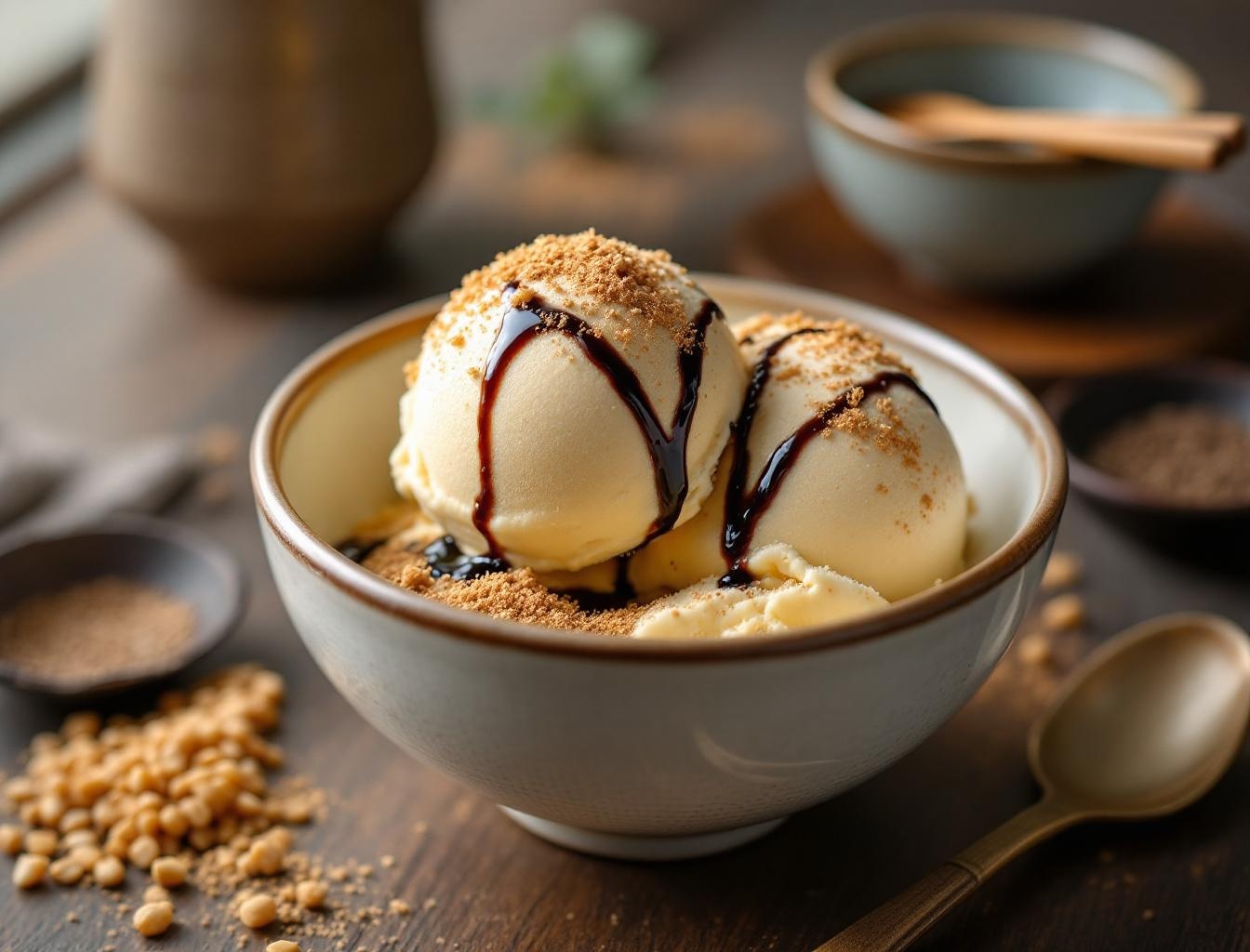
Kinako Ice Cream with Kuromitsu: Japanese Roasted Soybean Flour Ice Cream
 Pat Tokuyama
Cookbook author
Pat Tokuyama
Cookbook author
Last updated: April 2026
Kinako ice cream with kuromitsu is one of those Japanese desserts that stops you mid-bite. The nutty, toasty warmth of roasted soybean flour folded into a rich custard base, then drizzled with dark, molasses-like black sugar syrup — it’s a flavor combination that’s been perfected over centuries in Japan, and one that translates beautifully into homemade ice cream. If you’ve ever had kinako dusted over mochi or swirled into a latte, imagine that same deep, roasted nuttiness in frozen form. This is comfort food at its finest.
Key Takeaways
- Kinako (きなこ) is roasted soybean flour — whole soybeans toasted until golden and ground into a fine powder — with a deep, nutty, toasty flavor unlike any Western ice cream ingredient.
- Kuromitsu (黒蜜) is a Japanese black sugar syrup made from Okinawan kurosatou; it adds mineral-rich, toffee-like depth that perfectly counterbalances kinako’s earthiness.
- The kinako + kuromitsu pairing is a centuries-old combination in Japanese sweets — from New Year’s mochi to summer warabimochi — and translates seamlessly into homemade ice cream.
- If kurosatou is unavailable, muscovado sugar is an 85–90% substitute; regular dark brown sugar is a more distant third option.
- According to USDA FoodData Central (2024), roasted soybeans provide approximately 35g of protein per 100g, making kinako one of the more nutritionally substantial ice cream add-ins available.
Growing up Japanese-American, kinako was one of those ingredients that always seemed to appear during the best moments — New Year’s celebrations with freshly pounded mochi, summer festivals where vendors dusted it over dango, and quiet afternoons when my mom would make simple kinako treats as a snack. The aroma of toasted soybeans is one of those sense memories that instantly transports me back. When I started developing ice cream recipes, turning kinako into a frozen dessert felt like the most natural thing in the world. Paired with kuromitsu — that rich, almost caramel-like black sugar syrup — it became something I now make every summer without fail. For more, see our guide on matcha ice cream. For more, see our guide on black sesame ice cream. For more, see our guide on anmitsu with agar dessert.
What Is Kinako?
Kinako (きなこ) is roasted soybean flour — whole soybeans that have been toasted until golden and then ground into a fine, fragrant powder. The roasting process transforms the beans from something relatively bland into an ingredient with a deep, nutty, almost peanut-butter-like flavor, but more delicate and complex. Think of it like the difference between raw almonds and toasted almonds — that Maillard reaction changes everything. Best for: dusting over mochi and dango, blending into wagashi sweets, folding into ice cream and lattes.
In Japanese cuisine, kinako shows up everywhere. It’s dusted over mochi (rice cakes — especially the New Year’s variety called kinako mochi), mixed into wagashi (traditional Japanese confectionery), blended into drinks, and used as a coating for dango (skewered rice flour dumplings) and warabimochi (a bracken-starch jelly dessert). It has a subtle sweetness on its own, but its real power is that toasty, roasted depth it brings to anything it touches.
Nutritionally, kinako is a powerhouse — it’s essentially concentrated soybean goodness, packed with plant protein, fiber, and isoflavones. According to USDA FoodData Central (2024), roasted soybeans provide approximately 35g of protein per 100g — one of the highest plant-protein concentrations of any culinary flour. But honestly, I use it because it tastes incredible, and the nutrition is just a bonus.
What Is Kuromitsu?
Kuromitsu (黒蜜) is Japanese black sugar syrup, made by dissolving kurosatou (Okinawan black sugar — an unrefined cane sugar from Okinawa Prefecture) in water and simmering it into a thick, dark syrup. If you’ve never had it, imagine something between molasses and a dark caramel sauce, but with more mineral complexity and less cloying sweetness. It has deep notes of toffee, a hint of bitterness, and an almost smoky quality that makes it completely addictive. Best for: drizzling over warabimochi, kinako ice cream, anmitsu, and any Japanese dessert that benefits from rich, dark sweetness.
The black sugar itself — kurosatou — comes primarily from Okinawa, where sugarcane has been cultivated for centuries. Unlike refined white sugar, kurosatou retains all the minerals and molasses from the cane, which is what gives it that distinctive dark color and complex flavor. I remember visiting Takayama during a trip to Japan and finding a small shop that sold handmade kuromitsu — the owner explained how the quality of the sugarcane and the slow cooking process made all the difference. That bottle didn’t survive the trip home.
You can buy kuromitsu at Japanese grocery stores, or you can easily make kuromitsu from scratch at home. It keeps well in the fridge and is wonderful drizzled over just about any dessert.
Why Kinako and Kuromitsu Work So Well Together
FROM OUR JAPANESE
Serve Your Kinako Ice Cream with Authentic Hojicha
Kinako ice cream and hojicha
Kinako and kuromitsu work so well together because their flavor profiles create a precise complementary contrast: kinako’s toasty, nutty warmth is deepened by kuromitsu’s mineral-rich dark sweetness, and each amplifies the other rather than competing. There’s a reason this pairing has been a staple of Japanese sweets for generations — the flavor chemistry is just right. Kinako brings toasty, nutty, warm notes with a subtle earthiness from the soybeans. Kuromitsu brings deep, dark sweetness with mineral complexity and that slight bitterness from the unrefined sugar. Together, they create a balance that’s greater than the sum of its parts.
Think of it like how salted caramel works — the contrast between the flavors actually amplifies both. The roasted quality of kinako gets a boost from kuromitsu’s toffee notes, while kuromitsu’s richness is tempered by kinako’s lighter, nuttier character. In ice cream form, this translates to a base that’s warm and toasty with a drizzle that adds depth and a slight chewiness as the cold syrup thickens against the frozen cream.
If you’ve enjoyed other Japanese ice cream flavors like matcha ice cream or black sesame ice cream, kinako with kuromitsu is the natural next step — it’s less well-known outside Japan but equally deserving of a spot in your rotation.
Kinako in Japanese Culture
Kinako’s role in Japanese food culture goes far deeper than just being a tasty topping. It’s woven into the fabric of seasonal celebrations and everyday life in ways that reflect Japan’s long relationship with soybeans — one of the country’s most essential crops.
During New Year’s (Oshogatsu — Japan’s most important annual holiday, celebrated January 1–3), kinako mochi is one of the quintessential celebratory foods. Freshly pounded mochi is rolled in a mixture of kinako and sugar, creating a simple but deeply satisfying treat that symbolizes good fortune for the coming year. In many households, making kinako mochi together is as much a part of the holiday tradition as the mochi-pounding itself.
In summer, kinako appears in cooling wagashi like warabimochi — those translucent, jiggly mochi-like sweets made from bracken starch (warabishinko), generously dusted with kinako and served with kuromitsu. Street vendors sell them at festivals, and convenience stores stock packaged versions throughout the warmer months. There’s something about kinako’s toasty flavor that works equally well in the heat of summer as it does in the cozy warmth of winter.
Kinako also has a place in the Japanese
More broadly, kinako connects to the deep tradition of soybean foods in Japanese cuisine — tofu, miso, natto, edamame, soy sauce. Japan has transformed the humble soybean into an entire culinary universe, and kinako represents perhaps its most elegant sweet application. It’s a reminder that some of the best flavors come from the simplest transformations — in this case, just roasting and grinding.
Can You Substitute Kurosatou with Muscovado?
Yes, you can substitute muscovado sugar for kurosatou when making kuromitsu, but they are not identical — muscovado is an 85–90% match at best. Muscovado sugar (also called Barbados sugar) is an unrefined cane sugar with a high molasses content, which makes it the closest widely available substitute for Okinawan kurosatou. Both are dark, moist, and intensely flavored compared to white or even brown sugar.
That said, there are differences. Kurosatou tends to have a deeper mineral quality and slightly more complexity — notes that come from the specific Okinawan sugarcane varieties and traditional processing methods. Muscovado leans a bit more toward straightforward molasses flavor. I’ve done side-by-side taste tests, and while muscovado makes an excellent kuromitsu substitute, it lacks some of the nuanced bitterness and depth that true kurosatou provides.
| Feature | Kurosatou (Okinawan Black Sugar) | Muscovado Sugar | Dark Brown Sugar |
|---|---|---|---|
| Flavor | Deep mineral complexity, toffee, slight bitterness, smoky nuance | Strong molasses, rich caramel, less mineral depth | Mild molasses, straightforward sweetness |
| Origin | Okinawa, Japan | Barbados / tropical regions | Various (refined + molasses added back) |
| Refinement Level | Unrefined — full molasses retention | Unrefined — high molasses content | Refined white sugar + added molasses |
| Availability | Japanese grocery stores, online | Most supermarkets, widely available | Every supermarket |
| Kuromitsu Suitability | ✅ Ideal — authentic flavor | ✓ Good substitute (85–90% comparable) | ⚠ Works in a pinch — noticeably different |
| Best for | Authentic Japanese desserts requiring full depth | When kurosatou is unavailable; a reliable everyday substitute | Last resort; baking recipes where depth matters less |
My recommendation: if you can find kurosatou (check Japanese grocery stores or order online), use it. If you can’t, muscovado is a solid 85-90% substitute that will still give you a delicious result. Regular dark brown sugar is a more distant third option — it’ll work in a pinch, but you’ll notice the difference.
Tips for Making Kinako Ice Cream
- Sift your kinako — Kinako can be clumpy, and those clumps won’t dissolve evenly into your custard base. Always sift it before adding to ensure a smooth, consistent texture throughout your ice cream.
- Prepare an ice bath before you start — Have a large bowl of ice water ready to go. Once your custard is cooked, you want to cool it down quickly to stop the cooking and prevent a skin from forming. Speed matters here.
- Temper your eggs properly — When adding hot milk to egg yolks, do it gradually — a ladleful at a time while whisking constantly. Dumping hot liquid into eggs all at once gives you sweet scrambled eggs, not custard.
- Cook the custard to 170°F (77°C) — This is your target temperature. Use an instant-read thermometer rather than guessing. The custard should coat the back of a spoon and hold a line when you draw your finger through it.
- Chill the base thoroughly — Ideally overnight, but at minimum 4 hours. A well-chilled base churns better and produces a smoother texture. Don’t rush this step.
- Pre-freeze your ice cream maker bowl — If you’re using a bowl-style machine, freeze the bowl for at least 24 hours before churning. A not-cold-enough bowl is the number one reason homemade ice cream doesn’t set properly.
Equipment You’ll Need
- Ice cream maker — A standard home machine with a pre-freeze bowl works great. Compressor models are convenient but not necessary for this recipe.
- Medium saucepan — For heating the milk and cream mixture and cooking the custard base.
- Fine-mesh sieve — Essential for straining the custard to remove any cooked egg bits and ensure silky smoothness.
- Large bowl set in ice bath — For rapid cooling of the cooked custard. A metal bowl works best since it conducts cold efficiently.
- Whisk — For tempering eggs and stirring the custard. A balloon whisk gives you the best control.
- Microwave-safe bowl — For warming the kuromitsu slightly before drizzling, which makes it easier to swirl into the finished ice cream.
Serving Suggestions
Kinako ice cream is wonderful on its own, but these combinations take it to another level:
- Dust with extra kinako — A light sifting of kinako over each scoop right before serving doubles down on that roasted soybean flavor and adds a lovely visual touch.
- Drizzle with kuromitsu — This is non-negotiable in my house. A generous drizzle of cold kuromitsu over the scoops creates the perfect sweet-nutty contrast. The syrup thickens beautifully against the cold ice cream.
- Serve alongside warabimochi — Kinako ice cream with warabimochi (bracken-starch jelly sweets, a classic summer wagashi) on the side is essentially a Japanese dessert dream plate. The textures complement each other perfectly.
- Pair with castella cake — A slice of Japanese castella next to a scoop of kinako ice cream is a combination that works surprisingly well — the honey notes in castella play off kinako’s nuttiness.
- Top with black sesame seeds — A sprinkle of toasted black sesame seeds adds crunch, visual contrast, and a complementary nutty flavor.
- Serve in monaka wafers — Press kinako ice cream between crispy monaka wafers (thin, crisp rice-flour shells traditionally used for Japanese sweets) for a Japanese-style ice cream sandwich. The thin, crispy shells shatter against the creamy ice cream.
- Enjoy alongside hojicha
tea — A cup of hojicha (Japanese roasted greentea ) is the ideal beverage pairing. The roasted notes in hojicha echo kinako’s toasty character, creating a deeply warming experience even with a cold dessert. - Make an affogato-style dessert — Pour a shot of hot hojicha or even strong matcha over a scoop for a Japanese twist on the Italian classic.
Variations
- Matcha kinako swirl — Prepare a concentrated matcha paste (matcha powder dissolved in a tiny bit of hot water) and swirl it through the kinako ice cream during the last few minutes of churning. The green
tea bitterness and kinako’s nuttiness are a classic Japanese pairing. - Mochi pieces — Cut small cubes of fresh or store-bought mochi and fold them into the ice cream just before transferring to your container. They stay chewy even when frozen and add a wonderful textural element.
- Extra kuromitsu ripple — For an even more dramatic kuromitsu presence, layer additional syrup as you transfer the churned ice cream to your container. Alternate ice cream and syrup so every scoop gets ribbons of black sugar sweetness.
- No-churn version — If you don’t have an ice cream maker, whip 2 cups of heavy cream to stiff peaks, fold in sweetened condensed milk mixed with kinako, and freeze for 6-8 hours. It won’t have quite the same texture, but the flavor is still excellent.
Where to Buy Kinako and Kuromitsu
Japanese grocery stores are your best bet for both ingredients. Chains like Mitsuwa, Nijiya, and Marukai carry multiple brands of kinako and kuromitsu. Look for kinako in the baking or mochi section — it’s usually in a small bag and very affordable.
Online retailers are another reliable option. Amazon carries several Japanese kinako brands, and specialty sites like Weee! and Japan Super often have better selections. For kuromitsu, you can find bottled versions from brands like Kuze Fuku and S&B.
Making kuromitsu from scratch is surprisingly simple if you can get your hands on kurosatou (Okinawan black sugar). It’s just sugar and water, simmered until syrupy. I have a detailed kuromitsu recipe that walks you through the whole process — it takes about 15 minutes and the homemade version genuinely tastes better than store-bought.
Storage
Kinako ice cream keeps well in the freezer for up to 2 weeks at peak quality. After that, it’s still safe to eat but may develop ice crystals and lose some of its smooth texture.
For the best results:
- Store in an airtight container — a loaf pan works well, but any freezer-safe container with a tight lid is fine.
- Press a piece of plastic wrap directly against the surface of the ice cream before closing the lid. This prevents freezer burn and ice crystal formation on top.
- When serving, let the ice cream soften for 5-10 minutes at room temperature before scooping. Homemade ice cream freezes harder than store-bought (no commercial stabilizers), so this step makes a big difference.
- Avoid repeated thawing and refreezing — take out what you need and return the container to the freezer promptly.
Nutritional Benefits of Kinako
Beyond its incredible flavor, kinako brings legitimate nutritional value to this ice cream — making it one of the more guilt-free indulgences in the frozen dessert world.
- High in plant protein — According to USDA FoodData Central (2024), roasted soybeans provide approximately 35g of protein per 100g — making kinako one of the most protein-dense flours used in dessert cooking. Even the amount used in this recipe adds a meaningful protein boost compared to standard ice cream.
- Rich in isoflavones — Soy isoflavones are plant compounds found abundantly in whole soybeans. Kinako is one of the richest dietary sources, retaining these compounds through the roasting and grinding process.
- Good source of fiber — Unlike refined flours, kinako retains the fiber from whole soybeans, which contributes to the slightly rustic texture and helps slow sugar absorption.
- Contains calcium and iron — Soybeans are naturally mineral-rich, and kinako retains these nutrients through the roasting and grinding process.
- Lower added sugar compared to many ice cream flavors — Because kinako itself has a natural subtle sweetness and deep flavor, you don’t need as much added sugar to achieve a satisfying taste. Combined with kuromitsu (which has more mineral content than refined sugar), this is one of the more balanced ice cream recipes you can make at home.
Of course, it’s still ice cream — cream, eggs, and sugar are the foundation. But as ice cream goes, you could do a lot worse nutritionally than kinako.
Kinako Ice Cream with Kuromitsu
Kinako Ice Cream with Kuromitsu is an earthy ice cream sweetened with Okinawan black sugar syrup. The base flavor of this ice cream is made of kinako (roasted soy bean flour) that not only deepens the flavor, but also adds a dense body to each bite. This is one ice cream that may just teleport your taste buds straight through heavens golden doors. Will you follow?
- Prep Time: 15 minutes
- Cook Time: 10 minutes
- Total Time: 25 minutes
- Yield: 8 people 1x
- Category: Dessert
- Cuisine: Japanese
Ingredients
Scale
Kuromitsu 黒蜜
- 100 grams kurosatou 黒砂糖 (black sugar)
- 1/4 cup water
- 1 tablespoon boiling water
Kinako Ice Cream Base
- 3 egg yolks
- 50 grams sugar
- 200 ml milk
- 400 ml cream
- 100 grams kinako きな粉
- 100 ml Kuromitsu 黒蜜
Instructions
Kuromitsu 黒蜜
- In a microwave safe bowl, mix the sugar and water together and try to break down the clumps as small as possible.
- Microwave the bowl for about 2-3 minutes to melt the sugar.
- If not completely melted, mix and microwave more in 15 second increments until most of the sugar is melted.
- Add the remaining tablespoon of hot water to help dissolve any remaining pieces. Set aside and allow to cool.
Kinako Ice Cream Base
- Using a medium pot, warm milk and sugar until just simmering. Meanwhile, whisk egg yolks with sugar until pale yellow.
- Once milk is simmering gradually add about 1/2-1 cup of the milk to egg yolk mixture while whisking.
- Add everything back to the pot while continuously whisking.
- Cook until temperature is 170 or mixture coats the back of a spoon. Turn off heat and immediately add in the kuromitsu and kinako.
- Transfer the mixture to to a bowl set in an ice bath. Add the cold cream to speed up cooling of the base.
- Whisk and allow to cool, once cooled sufficiently follow manufacturer instructions to churn the ice cream!
- Serve with a dusting of additional kinako flour on top and enjoy!
Nutrition
- Serving Size: 1 scoop (approximately 150g)
- Calories: 330
Kinako Ice Cream FAQ
What does kinako ice cream taste like?
Kinako ice cream tastes warm, toasty, and nutty — often compared to peanut butter but more subtle, complex, and distinctly Japanese. There’s an earthy depth from the roasted soybeans and a gentle sweetness that pairs beautifully with the rich custard base. When drizzled with kuromitsu, you get an added layer of dark, toffee-like sweetness. It’s unlike any Western ice cream flavor — familiar yet completely unique.
Is kinako the same as soy flour?
No — kinako and regular soy flour are fundamentally different products, and one cannot substitute for the other. Regular soy flour is made from raw or lightly processed soybeans and has a beany, somewhat unpleasant raw flavor. Kinako is made from fully roasted soybeans, which completely transforms the taste into something nutty, toasty, and aromatic. The flavor difference is night and day.
Can I make this without an ice cream maker?
Yes — a simple no-churn method works well for kinako ice cream. Whip 2 cups of heavy cream to stiff peaks, then fold in a mixture of one 14oz can of sweetened condensed milk whisked with 3-4 tablespoons of kinako. Pour into a loaf pan, drizzle with kuromitsu, swirl gently, and freeze for at least 6 hours. The texture will be denser than churned ice cream, but the flavor is still wonderful.
Is kinako ice cream gluten-free?
Yes — kinako ice cream is naturally gluten-free, as kinako is made purely from roasted soybeans. As long as your other ingredients (cream, sugar, eggs) are gluten-free (which they typically are), this ice cream is safe for those avoiding gluten. However, always check the kinako packaging for cross-contamination warnings if you have celiac disease.
Where can I find kinako?
Japanese grocery stores are the most reliable source for kinako — look for it in the baking or mochi section. Chains like Mitsuwa, Nijiya, and H Mart are good options. It’s also available on Amazon and specialty online retailers. A single bag is inexpensive and will last you multiple batches of ice cream plus plenty of other uses.
Can I use this as a base for other kinako desserts?
Absolutely — this kinako custard base is highly versatile and works across many dessert formats beyond ice cream. Before churning, it works beautifully as a kinako crème anglaise sauce over castella cake or fresh fruit. You can also use the base to make kinako panna cotta (add gelatin), kinako frozen yogurt (substitute Greek yogurt for some of the cream), or kinako milkshakes (blend the churned ice cream with milk). The flavor profile is versatile enough to cross into many dessert formats.
How does kinako ice cream compare to matcha ice cream?
Kinako ice cream and matcha ice cream are both quintessentially Japanese, but their flavor profiles are nearly opposite — kinako is warm, toasty, and nutty, while matcha is bright, vegetal, and bitter. If you enjoy hojicha ice cream, you’ll likely love kinako — both share that roasted quality. Many people who find matcha too bitter or grassy discover kinako is more to their liking.
| Feature | Kinako Ice Cream | Matcha Ice Cream |
|---|---|---|
| Flavor Profile | Warm, toasty, nutty, earthy | Vegetal, slightly bitter, grassy, bright |
| Color | Golden cream | Vibrant green |
| Base Ingredient | Roasted soybean flour | Ground shade-grown green |
| Bitterness Level | Low — gentle, nutty finish | Moderate to high — characteristic astringency |
| Classic Pairing | Kuromitsu, hojicha, warabimochi | Azuki bean, mochi, white chocolate |
| Closest Western Analogue | Toasted hazelnut or peanut butter — but more refined | Dark chocolate in terms of bitterness balance |
| Best for | Those who prefer warm, roasted, nut-forward flavors; matcha skeptics | Those who enjoy bold, bitter, green |
Can I use kinako in other frozen desserts?
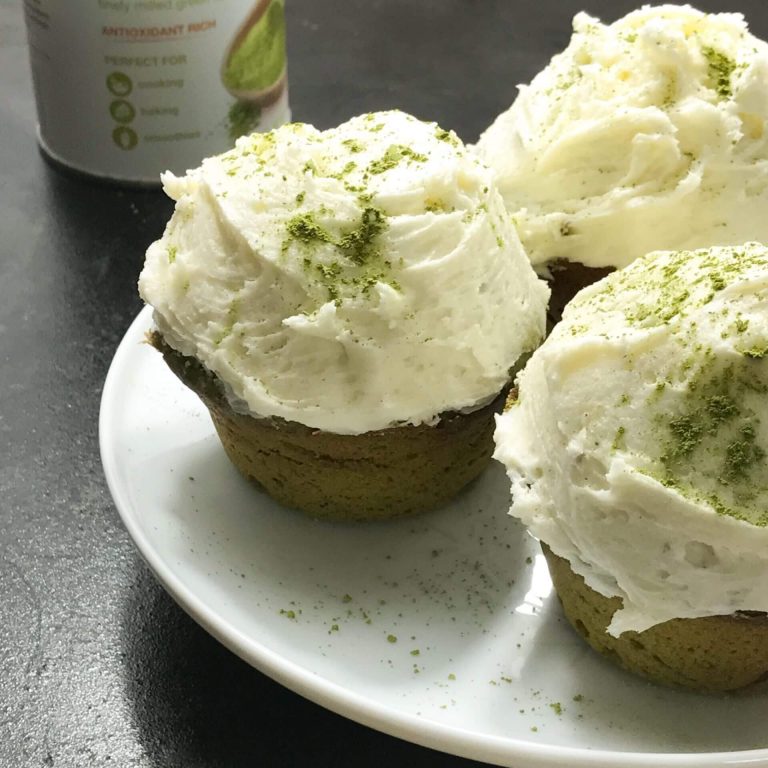
Definitely — kinako is exceptionally versatile in frozen applications beyond ice cream. Blend it into smoothies with banana, milk, and a drizzle of honey for a protein-rich breakfast drink. Use it in parfaits by layering kinako ice cream with granola, kuromitsu, and fresh fruit. Make kinako milkshakes by blending the ice cream with milk and a touch of kuromitsu. You can even fold kinako into frozen yogurt bark — spread yogurt on a sheet pan, dust with kinako and toppings, freeze, and break into pieces. It also works as a topping for matcha cupcakes with a kinako buttercream twist.
Want to master more Japanese recipes and techniques? Check out my cooking programs where I share the methods, ingredients, and cultural background behind authentic Japanese home cooking. Whether you’re just starting out or looking to level up your skills, there’s something for every level.
Which Japanese Tea Are You? Take the 60-second quiz
🍵 Enjoyed this recipe? Take our 60-second quiz: What Hojicha Treat Should You Bake?
Get a personalized recommendation — plus a discount code for your first order.
I went to Japan in March and got the exact ingredients to make this recipe by chance. I finally had the time to make it and this ice cream was absolutely delicious! I’ve never tasted anything like it. Thank you for the recipe and I can’t wait to make more!
Oh wow, I’ve been meaning to stop by forever and missed so many ice-cream posts! I loved hearing about this ice-cream and I have to say it looks outstanding!
thank you Mollie! 🙂
Thank you Pat for following me and for all the explanations on the ingredients. Guess what? Thanks to our son and his wife (who is from Tokyo), we will be visiting Japan for the very first time next year. I am keeping an eye on your recipes, as I hope to bring back some of the ingredients you mention on your blog.
thanks for the note! i’m excited for you! do you already have an itinerary? i plan to visit next year myself too, i cant wait!!
Well, we are going to stay in the capital. We were recently gifted a guide on Tokyo, so I am not worried: lots to see for a first trip to Japan! What about you?
yes there is! aside from osaka and tokyo no definitive plans yet! i need to start planning soon though since restaurants do get booked way in advance 😀
This would taste amazing!
thank you Eva! 🙂
The ice cream sounds awesome! I really want to taste it when I find it! I have never seen kinako ice with kuromitsu here in mainland Japan yet! ( I have never been Okinawa even thought I am Japanese)
thank you Yumi! i think i saw haagen dazs make it one time, but i agree it might be difficult to find 🙂
Interesting! It might be limited only in the limited area. I have never seen one in Hagen Dazs. I hope I can see one some time!
Sadly, Hagen Dazs has gotten rid of my favourite flavours (Mayan Chocolate, French Vanilla, and maybe Green Tea–I haven’t seen that one for a while either). It’s about the only ice cream brand I eat other than homemade.
agreed haagen dazs is one of my favorites! i actually used to work at haagen dazs. it was my first job. and despite that, for the longest time i thought it was a German brand but its American!
Yeah, made to sound German. That’s interesting that you worked there.
I really liked that the vanilla flavour of HD was the only vanilla ice cream on the market (in my area, at least) that didn’t use ANY thickeners, gelatins, fillers, etc., natural or not. The ingredients were something like cream, milk, sugar, egg yolk, vanilla, and nothing else.
Apart from eating only pure food, I wanted to support the concept and the company.