The Science of Sushi: Rice, Fish, Temperature, and Technique
Sushi is a precision food. A nigiri where the rice is cold, loosely packed, or the wrong temperature will disappoint regardless of the fish quality. A maki roll cut poorly falls apart at the table. Understanding the food science behind each element — the vinegar equilibrium in shari, the protein denaturation in fish, the role of temperature throughout — turns good sushi into exceptional sushi and explains why the best sushi restaurants obsess over details that seem excessive until you taste the difference.
The Science of Sushi Rice (Shari)
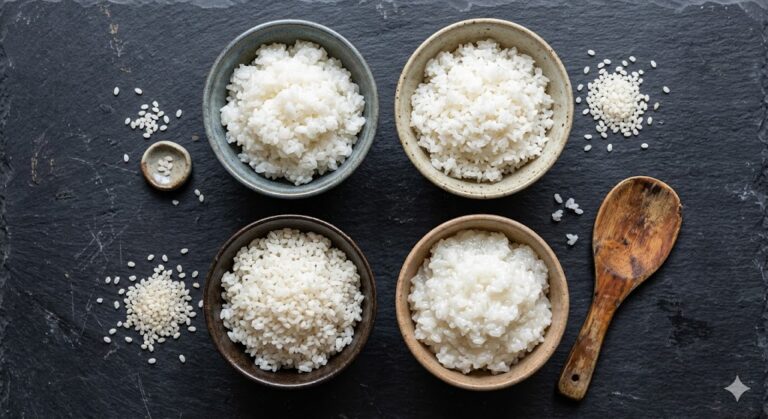
Sushi rice is not seasoned rice. It’s a precisely engineered component with specific starch behavior, moisture content, and acid-salt balance. Getting it right is the foundation of everything.
Starch Gelatinization and Retrogradation
When rice cooks, starch granules absorb water and gelatinize — swelling and softening into the cohesive structure we recognize as cooked rice. The starch consists of two components: amylose (long, linear chains) and amylopectin (branched chains). Japanese short-grain rice (Oryza sativa japonica varieties like Koshihikari) contains a higher proportion of amylopectin than long-grain varieties. Amylopectin is what makes short-grain rice sticky — it doesn’t retrograde (crystallize) as rapidly when cooled, maintaining a softer, cohesive texture.
The sushi chef’s challenge: keep the rice at a temperature where it’s cohesive but not so hot it steams the fish, not so cold it becomes starchy and unpleasant. The ideal service temperature for nigiri rice is 35–40°C (95–104°F) — approximately skin temperature. This is why skilled sushi chefs form nigiri immediately before serving.
Rice Vinegar Chemistry
Sushi su (the vinegar dressing) is a solution of rice vinegar, sugar, and salt. The acetic acid in vinegar serves several functions:
- Flavor development: The sharp brightness of vinegar balances the richness of fatty fish and the sweetness of rice
- Texture modification: Acid slightly softens the outer layer of rice grains while preserving interior structure, creating the distinct outer-soft, inner-firm texture of well-made shari
- Antimicrobial effect: The mild acidic environment inhibits bacterial growth — historically essential before refrigeration; still valuable for quality and safety
- Emulsification assistance: The acid-salt combination helps the starch surface absorb and retain the dressing evenly
The ratio of acetic acid to sugar to salt varies by region and chef. Edomae (Tokyo) style shari tends to be more vinegary and less sweet; Osaka style is softer and sweeter. Neither is correct — they reflect different aesthetic traditions.
Cooling Method: The Hangiri
Traditional sushi rice is cooled in a hangiri — a wide, shallow wooden tub, traditionally made from hinoki (Japanese cypress). The wood absorbs excess moisture as the rice cools, preventing the surface from becoming wet and sticky. Fanning while folding (not stirring, which breaks grains) accelerates evaporative cooling while distributing the dressing. The goal is rice that reaches 35–40°C with each grain coated but not waterlogged.
Fish Quality, Freshness, and Umami Chemistry
Aging Fish for Sushi: The Umami Cascade
Contrary to popular belief, the best sushi fish is not always the freshest. Ikejime (neurological killing technique that prevents lactic acid buildup) combined with controlled aging — called nekazari or simply aging — develops umami compounds that don’t exist in just-caught fish.
When fish muscle cells die, enzymatic activity begins breaking down proteins and nucleotides:
- ATP (adenosine triphosphate) → ADP → AMP → IMP → HxR → Hx
- IMP (inosine monophosphate) is a powerful umami compound — it peaks 24–72 hours post-harvest depending on species and temperature
- IMP then degrades to hypoxanthine (bitter) — the aging window is IMP peak minus degradation onset
White fish (hirame/flounder, tai/red snapper) typically benefit most from aging — they have lower intrinsic fat and flavor, and the umami development from 2–5 days of proper aging dramatically improves the eating experience. Fatty tuna (toro) has so much fat-derived flavor that aging matters less. Shellfish (scallop, clam) are eaten fresh — their enzymes degrade quality rapidly.
Fat Distribution: Why Toro Tastes Different
Bluefin tuna contains three primary cuts classified by fat content:
| Cut | Japanese Name | Fat Content | Flavor Profile |
|---|---|---|---|
| Lean loin | Akami | 1–3% | Clean, mineral, iron-forward, slight chew |
| Medium fatty | Chutoro | 10–20% | Balance of richness and brightness, melt quality begins |
| Fatty belly | Otoro | 25–40% | Maximum richness, melts on the palate, minimal resistance |
The “melting” quality of otoro is fat melting at body temperature — the intramuscular fat (similar in concept to marbling in wagyu) liquefies as you eat, producing the sensation of richness dissolving rather than having to be chewed. Otoro from the belly near the pectoral fin (kami-toro) commands the highest prices; from the mid-belly (naka-toro) is the most balanced.
Protein Denaturation and Texture
Fish proteins denature (unfold and restructure) at lower temperatures than meat proteins — most fish proteins denature around 40–65°C (104–149°F), compared to 60–70°C+ for many meat proteins. This explains why fish “cooks” very quickly with heat and why thin slices of fish used in sushi are essentially in a delicate equilibrium — just above the denaturation threshold could be warm shari rice, just below is raw.
Nori: Hydration, Texture, and the Cut
Nori quality for sushi maki and temaki is evaluated on three properties: texture, flavor intensity, and hydration behavior.
Nori Structure and Moisture
Nori sheets are dried at precise moisture levels. Too dry and they crack during rolling; too moist and they’re soft and don’t provide the satisfying snap when cut or bitten. The ideal moisture content for sushi nori is 4–8%. Fresh nori kept sealed will absorb ambient humidity — which is why opened packs must be used quickly or resealed airtight.
When nori contacts moist rice, it begins absorbing moisture immediately. A correctly assembled maki roll should be cut within 5–15 minutes of rolling — long enough for the nori to begin softening slightly (preventing cracking when cut) but not so long it becomes soggy throughout. The distinction between crisp nori and soft nori maki is primarily a timing question.
Nori Grades
- First-grade (ichi ban): Harvested in early season (October-November), deep black color, intense umami, thin and uniform. Used for premium maki and rolls where nori flavor is prominent
- Second-grade (ni ban): Later harvest, slightly less intense, adequate for most applications
- Lower grades: Thicker, lighter green-brown, less uniform — used in commercial sushi where nori is a supporting element
Wasabi: Real vs Imitation and Its Biochemistry
Real wasabi (Wasabia japonica) and the green paste served at almost all non-premium sushi restaurants are biochemically different products that interact differently with the palate.
Real Wasabi (Hon-Wasabi)
The active compound in fresh wasabi is allyl isothiocyanate (AITC) — produced when the cells of the rhizome are ruptured during grating. AITC is volatile and water-soluble, producing the characteristic nasal-clearing heat that dissipates rapidly (within 15–20 minutes of grating). This is why premium sushi restaurants grate wasabi to order on shark-skin graters: the potency exists only in freshly grated form. The heat is primarily sensed via trigeminal nerve pathways in the nasal passage — not on the tongue.
Imitation Wasabi
Most commercial “wasabi” is a mixture of horseradish (Armoracia rusticana), mustard, and green food coloring. Horseradish also produces AITC via a similar mechanism, but the flavor profile is different — harsher, longer-lasting, and primarily tongue-focused rather than nasal. Imitation wasabi retains potency because it’s preserved in a paste form rather than freshly grated.
The Role of Temperature Throughout the Meal
| Component | Ideal Serving Temperature | Why |
|---|---|---|
| Shari (nigiri rice) | 35–40°C (95–104°F) | Cohesive, slightly warm — enhances fat melt in toro |
| Lean fish (akami, white fish) | 5–10°C (41–50°F) when presented | Preserves texture; warms to eating temp on rice contact |
| Fatty fish (toro, salmon) | Slightly warmer than lean fish | Cold slows fat melt; very cold toro doesn’t fully melt |
| Tamago (egg) | Room temperature | Cold tamago is dense and rubbery |
| Green | Hot (75–85°C) | Palate cleanser, cuts richness between pieces |
| Ginger (gari) | Chilled to room temp | Palate reset between different fish |
Knife Science: Why the Cut Matters
Sushi knives (yanagiba for slicing sashimi, usuba for vegetables, deba for breaking down whole fish) are single-bevel blades — sharpened on one side only. This design produces a cleaner cut with less cell rupture than double-bevel blades.
When you cut through fish with a dull knife, you’re compressing and tearing cells rather than slicing them. Ruptured cells release fluids — and those fluids carry flavor compounds, surface moisture, and texture qualities outside the cut surface. A single pull of a razor-sharp yanagiba through a piece of tuna damages perhaps 1–2 cell layers on each cut face; a dull knife or push-cutting technique damages many more. This is why sushi chefs maintain their knives obsessively and why sashimi cut by a skilled knifeworker and the same fish cut by a dull knife tastes different.
Frequently Asked Questions
Why does sushi rice get hard and dry so quickly?
Starch retrogradation — the amylose and amylopectin chains begin re-ordering into crystalline structures as the rice cools below about 60°C and particularly as it approaches refrigeration temperature. Refrigeration dramatically accelerates retrogradation. Sushi rice is designed to be eaten within 1–2 hours of preparation, never refrigerated. Once refrigerated, the texture cannot be fully recovered by reheating.
Is sushi rice supposed to be sticky?
Cohesive, not sticky. There’s a meaningful difference: good shari should hold together when formed and release cleanly when eaten, not clump into a dense mass. Over-wet rice (too little evaporation during cooling, too much vinegar dressing) becomes gummy. Over-starchy rice (wrong variety, over-washed) becomes paste-like. Japanese short-grain rice varieties balance cohesion and clean separation when properly prepared.
Why do high-end sushi restaurants not serve soy sauce with every piece?
Because the chef has already seasoned the fish at the moment of service — brushing nitsume (reduced dashi-soy glaze) or dabbing nikiri (chef-grade diluted soy) on pieces that benefit from it. Dipping in soy sauce adds more salt than necessary, can overpower delicate white fish flavors, and soaks the rice (which breaks it apart). At an omakase counter, the chef’s seasoning is the intended experience.
What makes sushi-grade fish safe to eat raw?
The term “sushi-grade” has no regulatory definition in most countries. In practice, fish safe for raw consumption has been: (1) sourced from clean, monitored waters, (2) handled under strict cold-chain protocols, (3) flash-frozen to -20°C (-4°F) for at least 7 days or -35°C for 15 hours — killing parasites including Anisakis. Deep-sea fish (tuna, most salmon used in sushi) are lower risk than freshwater or coastal fish. The FDA recommends freezing as the key parasites-control measure.