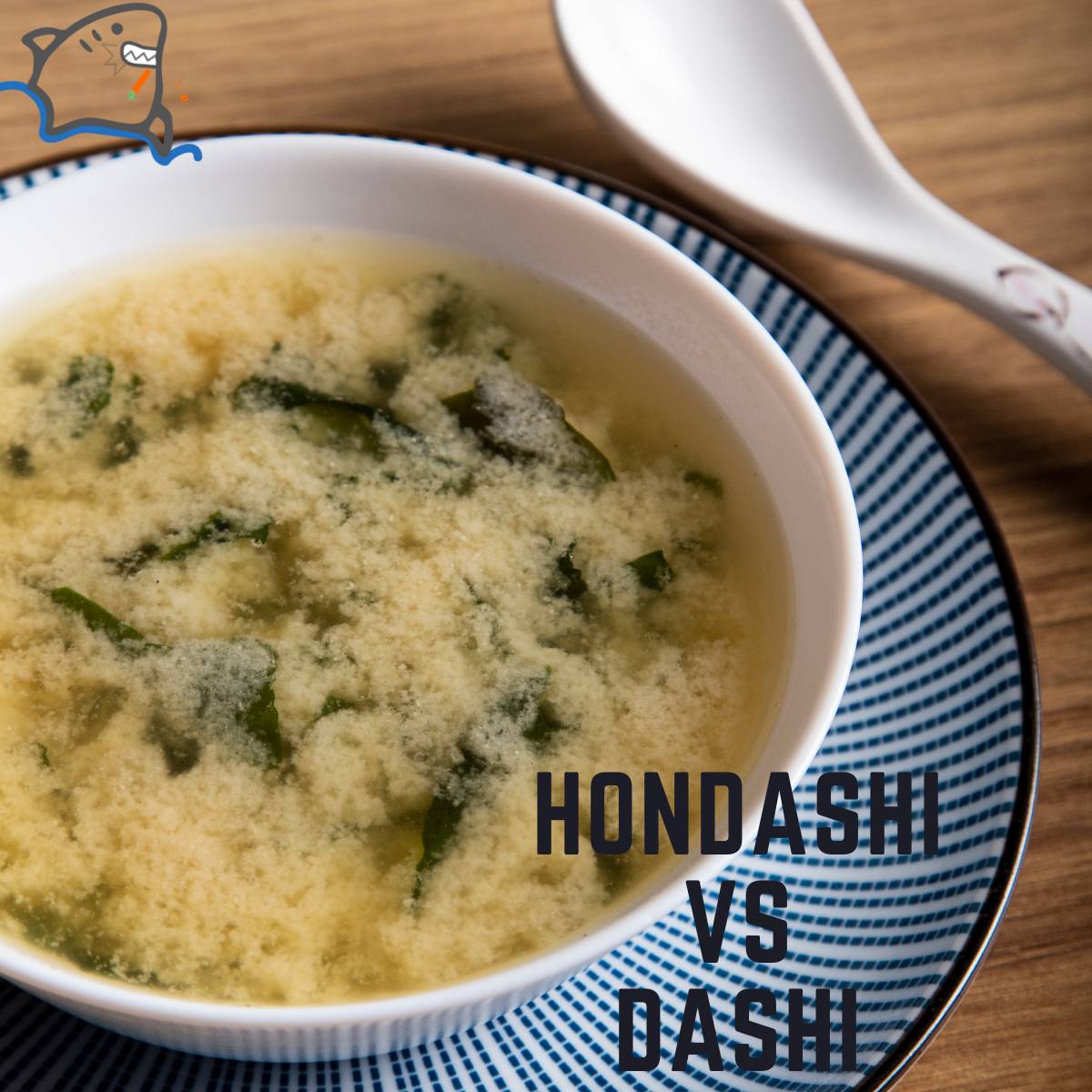
Hondashi vs Dashi: What’s the Difference? (And When to Use Each)
My obachan (grandmother) in Japan kept two things in her kitchen without fail: a container of kombu (dried kelp seaweed) and katsuobushi (dried, smoked, fermented bonito tuna shaved into flakes) for proper dashi, and a jar of Hondashi for weeknights when she didn’t feel like it. That told me everything about the hondashi vs dashi debate — it’s not about which is “authentic,” it’s about knowing when to use each.
Last updated: April 2026
Quick answer: Hondashi is Ajinomoto’s brand-name instant dashi powder — made from bonito extract, MSG, salt, and sugar — that dissolves in seconds. Traditional dashi is homemade Japanese soup stock simmered from kombu and katsuobushi (dried bonito flakes). Hondashi trades some flavor complexity for convenience. Both belong in a real Japanese kitchen — it’s about knowing which situation calls for which.
Key Takeaways
- Hondashi is Ajinomoto’s instant dashi powder (bonito extract, MSG, salt, sugar); traditional dashi is freshly made stock from natural ingredients like kombu and katsuobushi — two fundamentally different products with different ideal uses.
- Scratch dashi is best when the broth itself is the star — clear soups (suimono), chawanmushi, kaiseki — while Hondashi excels in everyday miso soup, nimono, and as a quick umami booster.
- There are five main types of traditional dashi (ichiban, niban, kombu, niboshi, and shiitake), each delivering a different flavor profile suited to different dishes.
- Hondashi contains approximately 270mg of sodium per teaspoon (per Ajinomoto’s label); scratch dashi is naturally very low in sodium. Sodium — not MSG — is the meaningful nutritional distinction.
- Dashi no moto (だしの素) is the generic category for instant dashi; Hondashi is one brand. Notable alternatives include Kayanoya (MSG-free, premium), Yamaki, Shimaya, and Ninben.
What Is Dashi? (出汁)
Dashi (出汁, だし) is the foundational soup stock of Japanese cuisine — an umami-rich liquid extracted from natural ingredients like kombu, katsuobushi, dried sardines, or shiitake mushrooms. Unlike Western stocks that simmer for hours, authentic dashi takes under 20 minutes — yet delivers an intense, clean umami that forms the backbone of miso soup, ramen broth, tamagoyaki, and countless other dishes.

The kanji 出汁 literally means “extracted juice” — and that’s exactly what it is: umami drawn out of natural ingredients by heat and water. Dashi was recognized as a cornerstone of washoku, which received UNESCO Intangible Cultural Heritage status in 2013.
The Five Main Types of Dashi
Not all dashi is the same. Depending on what you steep and how you use it, the flavor profile changes completely:
- Ichiban dashi (一番だし) — First brew: The most delicate and prized. Made by briefly steeping kombu in water, then adding katsuobushi and straining quickly. Used for clear suimono soups and premium dishes where the broth itself is the star.
- Niban dashi (二番だし) — Second brew: The spent kombu and katsuobushi from ichiban dashi get simmered longer for a stronger, earthier stock. Everyday miso soup, simmered dishes (nimono), and noodle broth territory.
- Kombu dashi (昆布だし) — Kelp only: Cold-steeped or gently heated kombu in water. Completely vegan and deeply umami. Used in shojin ryori (Buddhist temple cuisine) and as a base for tofu dishes.
- Niboshi dashi (煮干しだし) — Dried sardine: Made from small dried anchovies (niboshi) simmered in water. Stronger, more assertive flavor with a slight bitterness. Classic for home-style miso soup in many regions of Japan, particularly in Kanto households.
- Shiitake dashi (椎茸だし) — Dried mushroom: Cold-steep dried shiitake mushrooms overnight. The cold extraction pulls out more guanylic acid — a distinct umami compound. Rich, earthy, vegan, and often paired with kombu dashi in vegetarian preparations.
Understanding which dashi type you’re making matters more than people realize — and it also clarifies why “just use hondashi” doesn’t apply to every situation.
What Is Hondashi? (ほんだし)
Hondashi (ほんだし) is the brand name of Ajinomoto’s instant dashi seasoning, first introduced in Japan in 1970. It comes as a light tan granulated powder that dissolves instantly in hot water — no straining, no simmering, no prep time beyond measuring.
The name is genuinely ironic: 本 (hon) means “real,” “true,” or “original” in Japanese. So Hondashi literally translates to “real dashi” — though it’s an instant manufactured product, not a traditional preparation. In Japan, the name signals “the authentic taste of dashi, made convenient” — not a claim to being scratch-made. The irony isn’t lost on Japanese cooks, who use it anyway because it works.
What Is Hondashi Made Of?
According to Ajinomoto’s official ingredient label, Hondashi contains:
- Salt — the primary seasoning base and the main sodium contributor
- Dried bonito powder and extract — the actual fish component; the extract is concentrated liquid bonito that’s been dried, while the powder is ground dried bonito
- Monosodium glutamate (MSG) — amplifies savory umami character by triggering the same glutamate receptors that make traditional kombu dashi taste rich
- Sugar — a small amount for balance, rounding out the saltiness
- Yeast extract — a natural source of additional glutamates and inosinates that adds depth
- Disodium inosinate (IMP) — occurs naturally in fish; works synergistically with glutamate to amplify umami perception significantly (the synergy effect is multiplicative, not additive)
- Disodium succinate — occurs naturally in shellfish and clams; adds a subtle brininess and complexity
What this combination achieves is a deliberate stacking of umami compounds — glutamates + inosinates — which is why even a small amount of Hondashi delivers a punch that homemade dashi takes real effort and quality ingredients to match.
What Does Hondashi Taste Like?
Hondashi has a savory, salty, smoky flavor with a distinct bonito character — the same kind of intense, slightly oceanic, fermented-fish depth you get from katsuobushi, but more concentrated and less nuanced. The flavor hits immediately and lingers, whereas a good homemade ichiban dashi has a cleaner finish with more layers that unfold as you eat.
A useful analogy: Hondashi is to scratch dashi what a good instant espresso is to a properly pulled shot. The instant version is unmistakably coffee — strong and functional — but the fresh version has aromatic complexity it can’t replicate.
Hondashi vs Dashi: Key Differences
| Feature | Hondashi | Traditional Dashi |
|---|---|---|
| Form | Granulated powder (instant) | Liquid (freshly made) |
| Main ingredients | Bonito extract, MSG, salt, sugar, yeast extract | Kombu + katsuobushi (or other natural ingredients) |
| Prep time | 30 seconds — dissolve in hot water | 15–20 min for ichiban dashi; overnight for cold kombu |
| Flavor complexity | Concentrated, intense, consistent | Nuanced, layered, varies by technique and ingredients |
| Contains MSG | Yes | No (natural glutamates from kombu and katsuobushi) |
| Sodium per serving | ~270mg per 1 tsp (4g) | ~20–50mg per cup (naturally low) |
| Shelf life | 1–2 years sealed; months after opening | 2 days refrigerated; 3 months frozen |
| Cost | ~$7–9 for 4.23 oz jar (~50+ servings) | Kombu ~$8–15/bag; katsuobushi ~$6–12/bag |
| Vegan-friendly | No (bonito/fish) | Yes, if kombu-only or shiitake dashi |
| Best for | Quick miso soup, weeknight cooking, seasoning boosts | Delicate clear soups, kaiseki, chawanmushi, premium dishes |
What Is Dashi No Moto — And How Does It Differ from Hondashi?
Dashi no moto (だしの素) is the generic Japanese category term for any instant dashi powder or seasoning — it literally means “dashi base” — and Hondashi is simply Ajinomoto’s brand-name version of it. They’re related the same way “Kleenex” and “facial tissue” are: all Hondashi is dashi no moto, but not all dashi no moto is Hondashi.
Other popular dashi no moto brands worth knowing:
- Kayanoya — premium brand, no MSG, made with high-quality bonito and kombu, comes in convenient sachets. Widely considered the best “clean label” option. Best for: cooks avoiding MSG who want premium instant dashi without additives.
- Yamaki — traditional bonito-forward dashi packets, widely used across Japan, strong quality-to-price ratio. Best for: everyday Japanese cooking with a traditional bonito-forward character.
- Shimaya — makes multiple varieties including kombu-only and shiitake versions; good for vegan cooks. Best for: vegan and vegetarian kitchens needing fish-free instant dashi.
- Ninben — artisanal producer, higher-end katsuobushi and dashi products from a company that’s been making katsuobushi since 1699. Best for: premium Japanese cooking where ingredient provenance matters.
Why does this matter? If a recipe calls for “dashi no moto,” Hondashi will work — but you might prefer an MSG-free alternative like Kayanoya if you’re avoiding additives, or a shiitake-based variety if cooking vegan. The brands are interchangeable in usage but differ significantly in ingredient quality and flavor profile.
Does Hondashi Contain MSG?
Yes — Hondashi contains monosodium glutamate (MSG), listed explicitly on Ajinomoto’s ingredient label. Here is what that actually means, with the scientific clarity the topic deserves.
What MSG actually is: Monosodium glutamate (MSG) is the sodium salt of glutamic acid — an amino acid that occurs naturally in tomatoes, Parmesan cheese, miso paste, soy sauce, mushrooms, anchovies, and kombu seaweed. Your body cannot distinguish between naturally-occurring glutamate and the MSG in Hondashi. They are chemically identical. The glutamate in your scratch-made kombu dashi triggers the same receptors as the MSG in Hondashi.
The “Chinese Restaurant Syndrome” myth: In 1968, a letter published in the New England Journal of Medicine described symptoms after eating Chinese food and speculated MSG was the cause. It was not a study — it was one person’s anecdote. Subsequent double-blind placebo-controlled research failed to demonstrate consistent causation between MSG consumption and symptoms in healthy individuals, even in self-identified “MSG-sensitive” people. The FDA classifies MSG as GRAS (Generally Recognized As Safe). The European Food Safety Authority reached the same conclusion.
The actual nutritional concern with Hondashi — sodium: Per Ajinomoto’s label, one teaspoon of Hondashi (4g) contains approximately 270mg of sodium. That’s real and worth knowing. Traditional scratch dashi contains very little sodium naturally. For anyone managing hypertension or a sodium-restricted diet, this is the genuine consideration — not the MSG.
Allergens: Hondashi is gluten-free. It contains fish (bonito), which is a significant concern for anyone with fish allergies. The standard Ajinomoto Hondashi formula does not contain wheat, dairy, or soy.
A note on atopic syndrome (アトピー): In Japan there’s cultural awareness around food additives and atopic dermatitis — for which some practitioners suggest reducing processed additives. If you or someone in your household has atopy, experimenting with MSG-free dashi alternatives (Kayanoya, scratch kombu dashi) is entirely reasonable, though the evidence specifically linking MSG to atopic flares in the general population is limited.
Bottom line: For healthy adults, Hondashi is safe in normal cooking quantities. The sodium content is the only legitimate nutritional consideration, and it’s manageable — 1 teaspoon dissolved in a 4-serving pot of miso soup contributes about 67mg of sodium per bowl from the Hondashi alone.
When Should You Use Hondashi vs. Scratch Dashi?
Use traditional scratch dashi when the dashi flavor itself needs to take center stage. Use Hondashi when dashi is a supporting background element. That single rule covers most situations — and it’s how Japanese cooks on both sides of the debate actually think about it, even professional ones.
Use traditional scratch dashi for:
- Suimono (clear soups) — the broth IS the dish. Hondashi is too aggressive and one-dimensional for a soup where the clarity and delicacy of dashi is the entire point.
- Chawanmushi (savory egg custard) — delicate steamed egg needs a clean, nuanced dashi that doesn’t overpower the egg protein or the garnishes.
- Kaiseki-level preparations — any dish where the individual character of the dashi itself needs to come through.
- Shabu-shabu broth base — clean cold-steep kombu dashi lets the flavor of quality meat and vegetables take center stage.
- Serious ramen broth from scratch — when you’re layering dashi with tare and fat for a complex bowl, starting with fresh dashi pays dividends.
Use Hondashi (without apology) for:
- Everyday miso soup — the miso paste itself is complex. Hondashi does this job well, and this is exactly how millions of Japanese households make miso soup on weeknights.
- Oyakodon and other donburi — the simmering sauce absorbs soy sauce, mirin, and sake; the nuance of scratch dashi is largely eclipsed here anyway.
- Nimono (simmered vegetables) — Hondashi works well in soy-seasoned braises where the seasoning is heavy.
- Takikomi gohan (seasoned mixed rice) — dissolved in the cooking liquid, Hondashi integrates seamlessly.
- Blanching water for vegetables — a pinch in the blanching water gives greens a subtle savory lift.
- Seasoning boost — sprinkle directly as an umami enhancer in stir-fries, fried rice, or egg dishes.
My grandmother used Hondashi in miso soup, nimono, and as a quick sprinkle on things. She made scratch dashi for suimono and for special occasions. That framework — using each where it fits — is how real Japanese cooks think about it.
How Much Hondashi Should You Use Per Cup of Water?
The standard Hondashi ratio is 1 teaspoon (4g) per 2 cups (500ml) of water for miso soup — but the right amount varies by dish. Here’s a practical reference table based on Ajinomoto’s published guidelines and standard Japanese cooking ratios:
| Dish | Hondashi Amount | Water Volume | Notes |
|---|---|---|---|
| Miso soup (standard) | 1 tsp (4g) | 2 cups / 500ml | Per 2 servings; adjust salt in miso accordingly |
| Noodle broth (light) | 1.5 tsp (6g) | 2 cups / 500ml | For udon or soba; add soy sauce + mirin separately |
| Nimono (simmered dishes) | 1 tsp (4g) | 1.5 cups / 375ml | Ratio is stronger since you add soy and mirin too |
| Oyakodon sauce | ½ tsp (2g) | ½ cup / 125ml | Combined with soy sauce, mirin, and sake |
| Seasoning (direct sprinkle) | Pinch (0.5–1g) | N/A | On eggs, rice, grilled vegetables |
| Blanching water | ½ tsp (2g) | 4 cups / 1L | For greens; subtle background flavor boost |
Start with less than you think you need — Hondashi is concentrated. You can always add more, you can’t undo over-salting. In Japan I’ve seen the same brand used for staff meals in restaurant kitchens while fresh dashi was prepared for the dining room. That tells you everything about where each belongs.
Hondashi vs. Bonito Flakes: What’s the Difference?
Hondashi and bonito flakes (katsuobushi) both derive from dried bonito fish, but they’re used in fundamentally different ways — Hondashi is an instant powder seasoning, while katsuobushi is a whole ingredient used to make fresh dashi or as a garnish.
Bonito flakes are dried bonito fish shaved into thin, almost translucent flakes through an extraordinary traditional process: the fish is simmered, smoked, sun-dried, and then inoculated with Aspergillus glaucus mold — repeatedly, over months — to break down proteins into amino acids and develop deep, complex umami. Premium grades (honkarebushi) can go through this cycle four or more times.
Hondashi contains bonito extract and powder — processed forms of the fish — alongside MSG and other additives. It’s convenient, consistent, and long-lasting. But to use an analogy: bonito flakes are to Hondashi what freshly ground coffee is to instant — related origins, different experiences.
| Feature | Hondashi | Bonito Flakes (Katsuobushi) |
|---|---|---|
| Form | Instant granulated powder | Thin shaved dried fish flakes |
| Primary use | Dissolve in water for instant dashi; sprinkle as seasoning | Steep in water for ichiban dashi; use as topping or garnish |
| Flavor character | Concentrated, consistent, smoky-savory | Aromatic, complex, nuanced — varies by grade |
| Additives | MSG, salt, sugar, yeast extract | None — pure dried fermented bonito |
| Prep time | 30 seconds | 15–20 minutes for proper ichiban dashi |
| Shelf life | 1–2 years sealed | Varies; best used within months of opening |
| Best for | Weeknight cooking, miso soup, quick umami boost | Premium clear soups, ichiban dashi, toppings on okonomiyaki and tofu |
For recipes that call for sprinkling dashi powder directly on food, Hondashi is the practical choice. For making proper ichiban dashi to serve as a clear soup, fresh bonito flakes deliver an aroma and delicacy that no powder can replicate.
Hondashi vs. Shiro Dashi: What’s the Difference?
Hondashi and Shiro Dashi (白だし) are both convenient dashi shortcuts — but they’re fundamentally different products. Hondashi is a dry powder dashi component you dissolve and then season yourself; shiro dashi is a ready-to-use liquid that is already fully seasoned.
Hondashi is a dry powder. You dissolve it in water to create dashi stock, or sprinkle it directly as a seasoning. It’s a dashi component — you still need to add soy sauce, mirin, and salt to season your dish separately.
Shiro dashi is a ready-to-use liquid seasoning made from dashi (usually kombu and katsuobushi) combined with light soy sauce (shiro shoyu or usukuchi shoyu), mirin, sake, and salt. It’s both dashi and seasoning in one bottle — an all-in-one solution that’s already balanced and ready to pour.
| Feature | Hondashi | Shiro Dashi (白だし) |
|---|---|---|
| Form | Dry granulated powder | Ready-to-use liquid |
| Contents | Dashi seasoning component only | Dashi + light soy sauce + mirin + sake + salt |
| How to use | Dissolve in water, then add seasonings separately | Pour directly — already fully balanced |
| Flavor control | High — you control salt, soy, sweetness | Lower — flavor is pre-set by the manufacturer |
| Color contributed | None | Light golden from shiro shoyu (white soy sauce) |
| Best for | Dishes where you want full control over seasoning | Chawanmushi, tamagoyaki, fast one-bottle seasoning without dark color |
When to use each:
- Use Hondashi when you want control over seasoning — you add the dashi foundation and build the flavor profile yourself.
- Use Shiro dashi when you want maximum speed and minimal dishes — a few tablespoons seasons a whole dish, contributes the golden color of light soy, and delivers complete flavor in one pour.
- Shiro dashi shines in chawanmushi, tamagoyaki, and any dish where you want a light golden hue without the color from dark soy sauce.
What Are the Best Substitutes for Hondashi?
Out of Hondashi? The best substitute depends on what you have and what the dish needs — dashi packets are the closest match, while kombu cold-steep is the freshest alternative. Here are the top options, ranked by convenience and flavor quality:
- Dashi packets (top recommendation) — Kayanoya dashi packets and similar contain real ingredients in a teabag format. Steep in hot water for 3 minutes, remove the bag. No MSG, richer flavor than Hondashi, and nearly as fast. The gold standard for instant dashi without additives. Best for: cooks who want the convenience of instant with clean-label ingredients.
- Shiitake dashi powder — Vegan, earthy, and deeply umami. Different flavor profile than bonito-based Hondashi but works well in miso soup, nimono, and noodle broths. Best for: vegan and vegetarian kitchens avoiding fish.
- Iriko (niboshi) dashi packets — Dried sardine dashi packets give a more assertive, mineral-forward flavor. Traditional in Kanto-style miso soup. Strong character that stands up to heartier dishes. Best for: bold, assertive home-style miso soup.
- Scratch cold-steep kombu dashi — Soak a 4-inch piece of kombu in 4 cups cold water for 30 minutes (or overnight in the fridge). Remove kombu before heating. Pure, vegan, very clean flavor with minimal effort. Best for: when you have time and want a naturally low-sodium, additive-free result.
- Fish sauce + water — In a genuine pinch: ½ teaspoon fish sauce per cup of water adds savory depth. Not identical to dashi but functions similarly in soups and braises when you have nothing else. Best for: emergency substitution only.
- Soy sauce + water + kombu — If you have kombu, simmer a small piece in water for 10 minutes, add a dash of soy sauce. A rough approximation for braising and simmered dishes. Best for: nimono and braises where seasoning is heavy anyway.
Important note on fresh shiitake: Don’t use fresh shiitake mushrooms as a dashi substitute. The drying process causes the cell walls to break down and release glutamates into water — fresh shiitake doesn’t do this. The flavor stays locked inside the fresh mushroom. Dried only.
How Do You Store Homemade Dashi?
Homemade dashi doesn’t keep long — it must be refrigerated and used within 2 days, or frozen for up to 3 months. Here’s how to handle it:
- Refrigerator: Up to 2 days in a sealed container. Ichiban dashi is most delicate and is best used within 24–36 hours for peak flavor.
- Freezer: Up to 3 months. Best method: pour into ice cube trays, freeze solid, transfer cubes to a zip bag. One standard ice cube is approximately 2 tablespoons — perfect for small-batch seasoning or adding to a sauce without thawing a whole batch.
- Label everything: Frozen dashi looks exactly like frozen water. Write the date and type (kombu, bonito, mixed) on the bag. You will regret not doing this.
Hondashi by comparison is shelf-stable: the sealed jar lasts 1–2 years. After opening, store in a cool dry place — not the refrigerator — and use within 12–18 months. If your granules have hardened and clumped, that’s humidity exposure, not spoilage. Break up the clumps and use it.
Where Can You Buy Hondashi and Dashi Ingredients?
Hondashi is widely available in the U.S. at Japanese grocery stores and online; scratch dashi ingredients require slightly more specialized sourcing for premium quality.
Hondashi (Ajinomoto):
- Japanese and Asian grocery stores — Mitsuwa, H-Mart, 99 Ranch, Marukai
- Amazon — the 4.23 oz jar runs $7–9; larger sizes offer better per-serving value
- Some mainstream grocery stores in areas with large Asian communities (Whole Foods occasionally carries it)
- In Japan: every supermarket, convenience store, and dollar-equivalent shop carries it
Katsuobushi and kombu for scratch dashi:
- Japanese grocery stores for the best quality
- Asian supermarkets carry serviceable everyday versions
- For premium ma-kombu from Hokkaido or honkarebushi katsuobushi, specialty Japanese online retailers are worth it
Price reality: A $7–9 jar of Hondashi makes 50+ servings — that’s under $0.20 per pot of miso soup. Good kombu ($10–15/bag) and quality katsuobushi ($8–12/bag) cost more upfront, but the bags last well if stored in airtight containers away from light. For a household making miso soup five or more times a week, Hondashi is the significantly more economical choice.
Frequently Asked Questions
Is hondashi gluten-free?
Yes. Standard Ajinomoto Hondashi does not contain wheat, barley, or rye. The ingredient list — salt, sugar, MSG, bonito extract and powder, yeast extract, and flavor enhancers — contains no gluten-containing grains. If you have celiac disease, verify the label on your specific package, as formulations can occasionally vary by production region.
Can I substitute hondashi for dashi in miso soup?
Yes, absolutely — this is one of Hondashi’s best uses. Dissolve 1 teaspoon of Hondashi in 2 cups of hot water, add your miso paste (dissolve it into a small amount of the hot dashi first to prevent lumps), add tofu and green onions, and you have miso soup in minutes. This is how most Japanese home cooks make weeknight miso soup.
Is hondashi the same as bonito powder?
No. Bonito powder is pure ground dried bonito — just the fish, nothing added. Hondashi is a seasoning blend containing bonito extract and powder plus MSG, salt, sugar, yeast extract, and flavor enhancers. Hondashi delivers more immediate, amplified umami because of the additive stack. Pure bonito powder has cleaner flavor but needs larger quantities to match Hondashi’s punch.
How long does hondashi last after opening?
Typically 12–18 months after opening, stored in a cool dry place. The printed best-by date on the jar is the most reliable guide. Hondashi doesn’t become dangerous after expiring — it gradually loses potency. A good test: smell it. Fresh Hondashi has a pronounced oceanic, savory, slightly smoky scent. If the aroma is faint or off, it’s past its prime. Clumped granules are a humidity issue, not spoilage.
Is hondashi vegan?
No. Hondashi contains bonito (fish) extract and powder. It is not suitable for vegans or vegetarians who avoid fish. For vegan instant dashi alternatives, look for kombu-only dashi packets, shiitake dashi powder (Shimaya makes one), or mixed kombu-shiitake versions.
What is the difference between hondashi and dashi no moto?
Dashi no moto (だしの素) is the generic Japanese category term for instant dashi seasoning — it means “dashi base.” Hondashi is Ajinomoto’s brand-name version. Other brands — Kayanoya, Yamaki, Shimaya, Ninben — also make dashi no moto products. The differences between brands come down to ingredient quality, MSG vs. no-MSG formulas, and flavor profile (some are more bonito-forward, some include kombu, some are shiitake-based).
Is hondashi healthy?
In moderate amounts, yes. The primary nutritional consideration is sodium — approximately 270mg per teaspoon per Ajinomoto’s label. The MSG content is safe for healthy adults: MSG is FDA-classified as GRAS, and multiple controlled studies have not supported the claim that MSG causes adverse reactions in the general population. If you’re on a sodium-restricted diet, scratch dashi or MSG-free dashi packets may be a better daily option.
Does hondashi expire?
It has a printed best-by date, typically 1–2 years from manufacture. After that date, flavor gradually degrades but it doesn’t become unsafe. Test it by smelling it — fresh Hondashi has a clear, oceanic, savory-smoky scent. If the aroma has faded significantly, replace it. Granule clumping is from moisture exposure, not spoilage; break them up and use it.
Summary & Conclusion
The hondashi vs. dashi debate often gets framed as a food purity argument — “real” Japanese cooking versus shortcuts. That’s not how Japanese cooks actually think about it, and it’s not a useful framing.
Dashi (出汁) is the flavor foundation of Japanese cuisine, extracted from natural ingredients — kombu, katsuobushi, dried sardines, or shiitake mushrooms. When the dashi itself is the star — in clear soups, delicate egg dishes, kaiseki preparations — making it from scratch absolutely pays off.
Hondashi is Ajinomoto’s instant dashi seasoning: a deliberate stack of bonito extract, MSG, salt, sugar, and flavor enhancers that dissolves in seconds and delivers consistent, strong umami. When you need dashi as a background element for miso soup, nimono, rice, or a quick seasoning boost — Hondashi is what Japanese families actually use every day. There’s no shame in it.
My grandmother used both. My pantry has both. The right answer to “which is better” is: know what the dish needs, and use the right tool.
If you’re stocking a Japanese kitchen for the first time, grab a jar of Hondashi and a bag of kombu. You’ll have fast everyday dashi covered and the foundation for scratch dashi whenever a dish deserves it. That’s a complete pantry for most Japanese home cooking.
Do you reach for Hondashi or make dashi from scratch? Let me know in the comments.